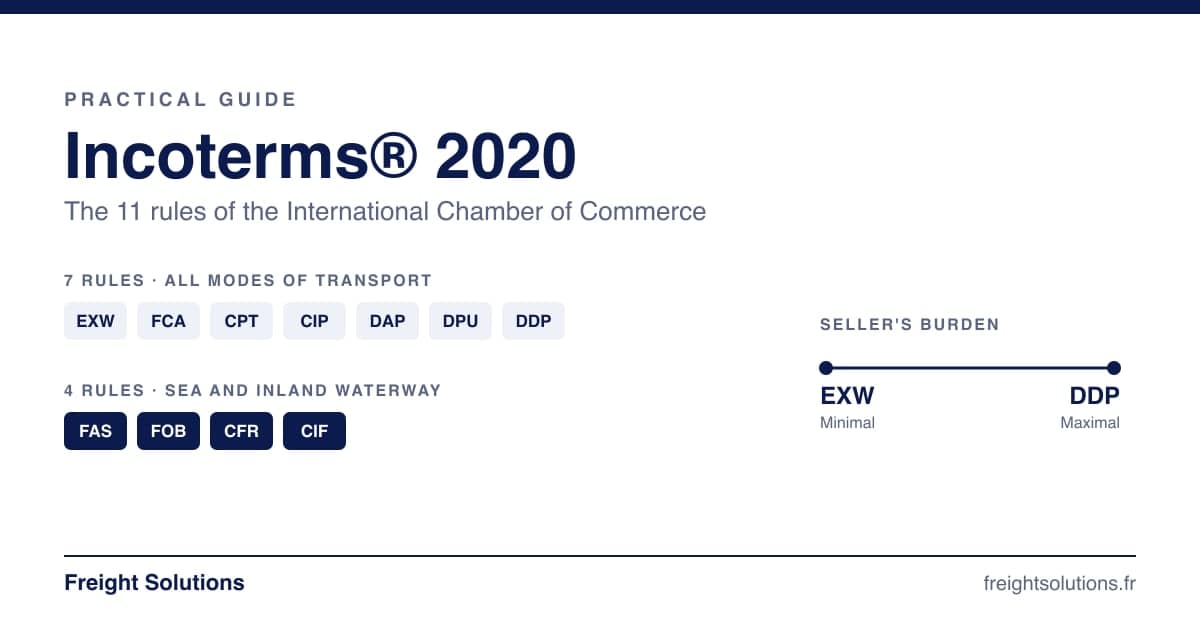
The Incoterms® (International Commercial Terms) are published by the International Chamber of Commerce (ICC). In force since 1 January 2020, the Incoterms® 2020 version is still the most recent in 2026: it defines who - buyer or seller - takes on transport, insurance and customs formalities, and at exactly which point risk passes from one party to the other. Choosing the right Incoterm means avoiding disputes, protecting your margin and keeping your operations running smoothly.
This guide reviews the 11 Incoterms® 2020 rules, their scope (multimodal or sea), the point at which risks and costs transfer, and the good practice we observe among our industrial, retail and e-commerce customers.
Two families to remember. The first 7 Incoterms (EXW, FCA, CPT, CIP, DAP, DPU, DDP) apply to any mode of transport, including multimodal. The last 4 (FAS, FOB, CFR, CIF) are reserved for sea and inland waterway transport, with a transfer of risk tied to the vessel.
The 11 rules at a glance
| Rule | Modes | Transfer of risk | Export customs | Import customs |
|---|---|---|---|---|
| EXW - Ex Works | Any mode | Placed at disposal, ready for loading | Buyer | Buyer |
| FCA - Free Carrier | Any mode | Handed to the nominated carrier | Seller | Buyer |
| CPT - Carriage Paid To | Any mode | Handed to the first carrier | Seller | Buyer |
| CIP - Carriage and Insurance Paid To | Any mode | Handed to the first carrier | Seller | Buyer |
| DAP - Delivered at Place | Any mode | At destination, ready for unloading | Seller | Buyer |
| DPU - Delivered at Place Unloaded | Any mode | At destination, after unloading | Seller | Buyer |
| DDP - Delivered Duty Paid | Any mode | At destination, ready for unloading | Seller | Seller |
| FAS - Free Alongside Ship | Sea / inland waterway | Alongside the vessel at the port of departure | Seller | Buyer |
| FOB - Free On Board | Sea / inland waterway | Goods loaded on board the vessel | Seller | Buyer |
| CFR - Cost and Freight | Sea / inland waterway | Goods loaded on board at departure | Seller | Buyer |
| CIF - Cost, Insurance and Freight | Sea / inland waterway | Goods loaded on board at departure | Seller | Buyer |
Only two rules require the seller to take out insurance: CIP (Institute Cargo Clauses A cover or equivalent) and CIF (minimum Institute Cargo Clauses C cover). The detail of each rule is set out below.
The 7 rules for any mode of transport
EXW - Ex Works : the seller places the goods at the buyer's disposal at the agreed place - usually its own premises - packed and ready for loading. Risk transfers to the buyer from that moment: loading, transport, export and import formalities are at the buyer's cost and risk. It is the Incoterm most favourable to the seller, but often awkward for a non-resident buyer (export formalities).
FCA - Free Carrier : the seller hands the goods over, cleared for export, to the carrier nominated by the buyer, either at its own premises - where it loads the collecting vehicle - or at another agreed place, where the goods are delivered ready for unloading. Risk transfers on that handover. FCA is today the recommended alternative to EXW and FOB for containerised flows.
CPT - Carriage Paid To : the seller pays for the main carriage to the agreed point, but risk transfers to the buyer as soon as the goods are handed to the first carrier. Watch the split between the point where costs transfer and the point where risks transfer.
CIP - Carriage and Insurance Paid To : identical to CPT, with the addition of insurance taken out by the seller for the buyer's benefit, in line with Institute Cargo Clauses (A) or equivalent cover, unless the parties agree otherwise. Risk nonetheless still transfers on handover to the first carrier, not at destination. It is the recommended Incoterm for high-value multimodal consignments.
DAP - Delivered at Place : the seller bears the costs and risks up to the point where the goods are placed at the buyer's disposal, ready for unloading, at the agreed destination. Import clearance remains the buyer's responsibility.
DPU - Delivered at Place Unloaded : successor to DAT, DPU is the only Incoterm that requires the seller to unload the goods at destination. The costs and risks of transport up to unloading are borne by the seller; import duties and taxes remain with the buyer.
DDP - Delivered Duty Paid : the seller bears the costs and risks up to the agreed destination and takes on all formalities - export, transit and import - as well as import duties and taxes. Unloading at destination remains, in principle, the buyer's responsibility. It is the most demanding Incoterm for the seller, to be handled with care if you are not familiar with the customs, tax and VAT obligations of the destination country.
The 4 sea and inland waterway rules
FAS - Free Alongside Ship : reserved for sea transport. The seller delivers the goods alongside the vessel at the agreed port of shipment, cleared for export. Risk passes at that moment. It suits bulk cargo and out-of-gauge packages in particular.
FOB - Free On Board : the seller delivers the goods on board the vessel nominated by the buyer at the agreed port of shipment, cleared for export. Risk and costs transfer once the goods are loaded on board the vessel - no longer at the “ship's rail”, a reference the ICC dropped with Incoterms 2010. Best avoided for containers, for which FCA is more suitable (the container is handed over at the terminal, not loaded on board by the seller).
CFR - Cost and Freight : the seller pays the sea freight to the port of destination, but risk transfers to the buyer as soon as the goods are loaded on board at the port of departure. As with CPT, the split between costs and risks is a contractual point to watch.
CIF - Cost, Insurance and Freight : identical to CFR, with the addition of minimum marine insurance (Institute Cargo Clauses C) taken out by the seller, often topped up by additional cover on the buyer's side. Risk still transfers on loading on board at the port of departure, even though the seller pays freight and insurance to the port of destination.
How to choose the right Incoterm
Three practical criteria guide the choice:
- The mode of transport: pure sea, or multimodal / containerised
- The level of control you want over the logistics chain
- Your command of customs and tax formalities in the destination country
An ill-suited Incoterm can generate extra costs, disputes or an allocation of responsibilities that was poorly anticipated on an international consignment.
The most frequent mistakes
The ones we correct most often for our customers:
- Using EXW for international shipments: a non-resident buyer cannot always clear the goods for export
- Using FOB for containers: prefer FCA at the terminal
- Not stating the exact place after the Incoterm: “FCA Bergheim, Freight Solutions warehouse” is safer than “FCA France”
- Agreeing to DDP without having checked the tax obligations of the destination country (import VAT, fiscal representative where applicable)
How we support you
At Freight Solutions, as manager and architect of freight flows, we advise our customers on the choice of Incoterm for every import or export operation: securing documents, coordinating the freight forwarder, handling customs, ad valorem insurance. Our customs team and our European and international transport plan support you across the whole chain, from the factory to the final delivery point.
Need a view on which Incoterm to use for your next consignment? Our team is available to analyse your flow and propose the safest and most economical configuration. Contact us from the Contact page of this site.
Please note: this guide gives a practical summary of the Incoterms® 2020 rules. It does not replace the official publication of the International Chamber of Commerce, and the choice of a rule has to be assessed contract by contract, according to the goods, the mode of transport and the applicable regulations.
Frequently asked questions
- Incoterms 2020 or Incoterms 2024: which version is in force?
- Incoterms® 2020, in force since 1 January 2020, is the most recent version published by the International Chamber of Commerce. There is no 2024 version. A contract may nonetheless continue to reference an earlier edition if it says so expressly.
- Which Incoterm for a sea container?
- FCA is generally recommended: the container is handed over to the carrier or to the terminal without the seller loading it on board. FOB remains suitable for goods actually delivered on board the vessel, such as bulk cargo.
- Who pays customs duties on import?
- The buyer, under every rule except DDP: in that case, the seller takes on the import formalities as well as the duties and taxes.
- What is the difference between CIP and CIF?
- Both add insurance taken out by the seller. CIP applies to any mode of transport with Institute Cargo Clauses (A) cover or equivalent; CIF is reserved for sea and inland waterway transport with minimum Clauses (C) cover. In both cases, risk has already transferred to the buyer during the main carriage.
Sources
- ICC: Incoterms® 2020 · official presentation of the 11 rules by the International Chamber of Commerce