A consignment note is not paperwork for its own sake: it is the evidence of the contract of carriage. It states what was handed over, by whom, in what condition and on what date. The day a claim arises, it is the first document everyone asks for.
This guide covers the ground: what the letters CMR actually stand for, the particulars the document must carry, who does what between sender, carrier and consignee, the deadlines for reservations on delivery, and the ceiling the Convention puts on compensation for loss or damage.
The CMR consignment note: what are we talking about?
CMR stands for the Convention on the Contract for the International Carriage of Goods by Road, signed in Geneva on 19 May 1956. It applies to any carriage of goods by road for reward when the place of taking over and the place designated for delivery are in two different countries, at least one of which is a party to the Convention. The domicile and nationality of the parties make no difference. It leaves aside only consignments carried under international postal conventions, funeral consignments and furniture removals, and it keeps applying when the loaded vehicle is itself carried by sea, rail or air for part of the journey without the goods being unloaded.
In everyday use, “the CMR” also means the document itself: the international consignment note. It is the sheet the driver produces at loading, has signed at unloading, and that everyone looks for the moment a package is missing. It records the contract, sets out its terms and travels with the goods from start to finish.
The Convention is explicit on a point that is often misread: the contract of carriage exists without it. The absence, irregularity or loss of the consignment note affects neither the existence nor the validity of the contract, which remains governed by the Convention. What is lost by doing without it is not the contract: it is the instrument of proof, and the presumptions attached to it.
Domestic or CMR: which document for which journey
Two regimes coexist, and the document is not the same. Carriage within France falls under the commercial code and the statutory standard contracts; carriage by road between two countries, at least one of which is a party to the Convention, falls under CMR. In both cases the document must be on board: French transport law requires a consignment note, domestic or international, to travel in the vehicle, on paper or in electronic form, and the transport company to keep it for two years.
| Domestic carriage (France) | International carriage (CMR) | |
|---|---|---|
| Governing text | Commercial code and the standard contracts of the transport code | Geneva Convention of 19 May 1956 |
| Document | Domestic consignment note | CMR consignment note |
| Minimum particulars | Set by ministerial order: parties, places, dates, nature and quantity of the goods | Set by the Convention, more detailed, including the reference to the CMR regime itself |
| Consignee's reservations | Reasoned protest within three days, public holidays excluded, for damage or partial loss | At the latest on delivery, or within seven days for non-apparent loss or damage |
| Compensation ceiling | That of the applicable standard contract, based on the weight of the consignment | 8.33 SDR per kilogram of gross weight short, in case of loss |
One movement can fall under both regimes when it is split into separate contracts, for instance an international trunking leg followed by a separate contract for final delivery in France: each contract then keeps its own rules, its own document and its own deadlines. Conversely, a single international contract of carriage performed by successive carriers stays entirely under the Convention. All the more reason for one contact to hold the file from collection to delivery.
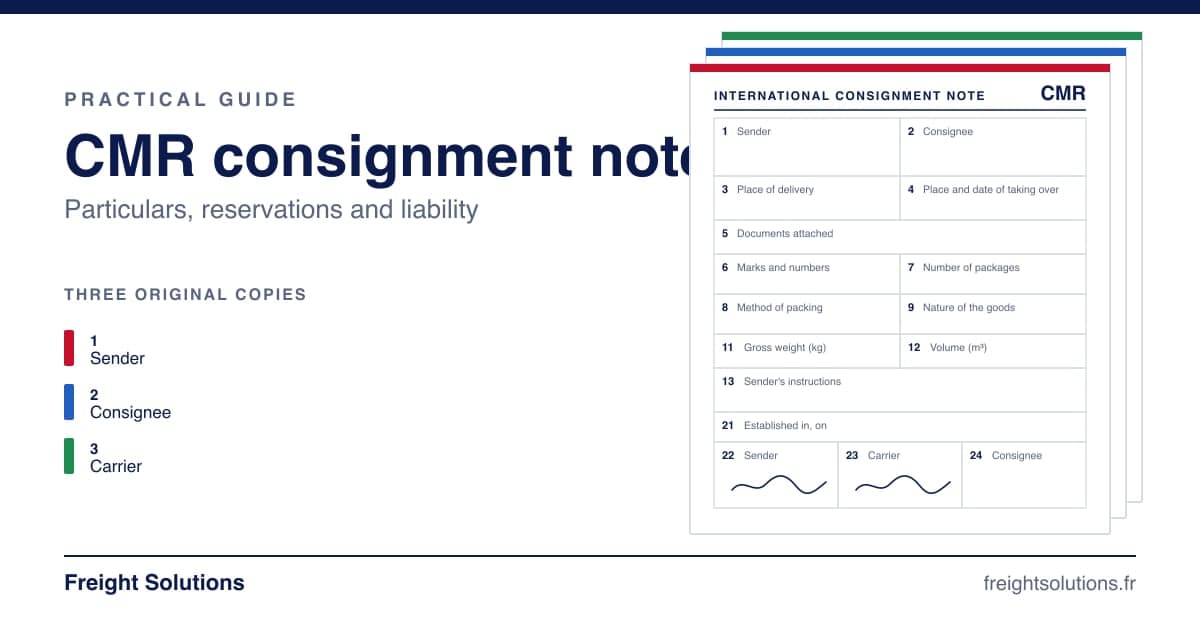
The mandatory particulars of the consignment note
The Convention lists what the consignment note must contain. The list is short and leaves no room for approximation: these are the lines on which disputes are settled.
| Particular | What it covers |
|---|---|
| Place and date of issue | Where and when the document was made out |
| Sender | Name and address |
| Carrier | Name and address |
| Taking over and delivery | Place and date of taking over, place designated for delivery |
| Consignee | Name and address |
| Nature of the goods | Common description and method of packing; recognised description for dangerous goods |
| Packages | Number, special marks and numbers |
| Weight | Gross weight, or quantity otherwise expressed |
| Charges | Carriage charges, supplementary charges, customs duties and other charges up to delivery |
| Customs | The instructions required for the formalities |
| Applicable regime | The statement that the carriage is subject to the CMR Convention, notwithstanding any clause to the contrary; leaving it out makes the carrier liable for the resulting costs and damage |
The French domestic regime is shorter. The order that governs it calls for the date the document was issued, the carrier's name, address and registration number, the date the goods were taken over, the nature and quantity of the goods, the names of the sender or of the party handing over the goods, and of the consignee, and the full addresses of the loading and unloading points.
Three copies, three uses
The consignment note is made out in three original copies, signed by the sender and by the carrier. These are not three copies out of courtesy: each has its holder and its use.
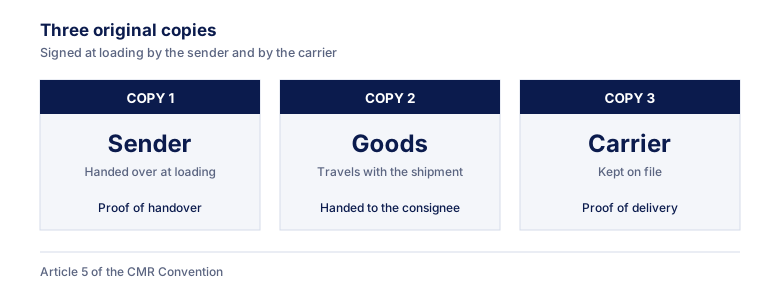
Where the goods have to be loaded in different vehicles, or where they are of different kinds or divided into different lots, either the sender or the carrier may require as many consignment notes as there are vehicles or lots. That is what makes it possible to trace a split shipment without losing the evidence for each part. On arrival, the consignee may require the second copy to be handed over with the goods, against a receipt: that copy is the consignee's own title. Nor is the first copy a mere receipt: it is by producing it that the sender exercises the right to dispose of the goods en route, to stop the carriage, change the place of delivery or the consignee, until that right passes to the consignee with the second copy.
Who fills in what
The consignment note is a shared document, which explains most disputes: each party is answerable for what it writes on it, and for what it leaves out.
| Stage | Who | What is at stake |
|---|---|---|
| Before collection | Sender | Describes the consignment and attaches the documents needed for the formalities. It answers for costs and damage caused by inaccurate or incomplete particulars, as for those caused by defective packaging. For dangerous goods, it informs the carrier of the exact nature of the danger and of any precautions to take: otherwise the carrier may unload or destroy them without compensation. |
| At loading | Carrier | Checks the apparent condition of the goods and their packaging, the number of packages, their marks and numbers. Reservations are entered here; otherwise it will be for the carrier to rebut the presumption. |
| At loading | Both | Sign the three copies. The first is handed to the sender. |
| On delivery | Consignee | Checks before signing. Taking delivery without reservation raises a presumption, until proven otherwise, of acceptance in good order. |
One point deserves to be said plainly. A driver who cannot check the contents, because the trailer was loaded and sealed by the sender, must say so on the document. A reasoned reservation displaces the presumption; a boilerplate reservation, entered systematically and without grounds, protects no one. Those reservations bind the sender only if it has expressly accepted them on the consignment note: an unaccepted reservation does not bind the sender, and its evidential value is weighed case by case. As for the weight and the contents of packages, checking them is not owed as a matter of course: the sender may require it, and the carrier may charge for it.
What the consignment note proves
The Convention gives it a precise evidential weight: it is prima facie evidence of the making of the contract, of its conditions and of the receipt of the goods by the carrier.
A presumption comes with it. In the absence of reasoned reservations by the carrier, the goods and their packaging are presumed to have been in apparent good condition when taken over, and the number of packages, their marks and their numbers to have matched the statements in the note. In other words: whatever was not challenged at loading is taken to be accurate.
Reservations on delivery: the deadlines not to miss
This is the costliest part of the subject. Loss or damage recorded too late, or notified through a channel the text does not provide for, becomes very hard to have compensated; for delay, it is a guillotine.
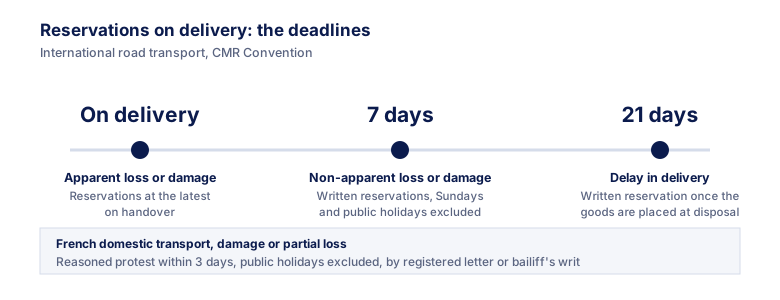
| Situation | International carriage (CMR) | Domestic carriage (France) |
|---|---|---|
| Apparent loss or damage | Reservations at the latest at the time of delivery | Precise reservations on delivery, then a reasoned protest within three days |
| Non-apparent loss or damage | Written reservations within seven days, Sundays and public holidays excluded | Reasoned protest within three days, public holidays excluded |
| Delay in delivery | Written reservation within twenty-one days of the goods being placed at disposal | As set by the applicable standard contract |
Two details change everything. In international carriage the day of delivery is not counted in the deadline, and reservations must be in writing as soon as the loss or damage is not apparent. Their effect differs too: for loss or damage, taking delivery without reservation merely raises a presumption of acceptance in good order, which can still be rebutted; for delay, without a written reservation within twenty-one days, no compensation is due at all. And a useful reservation is a precise one: nature of the damage, packages affected, quantities. “Subject to unpacking” has never proved anything.
Under the French domestic regime, the three-day reasoned protest covers only damage and partial loss, total loss falling outside it, and it is served by registered letter or by bailiff's writ; a request for a court-appointed survey made within the same period counts as a protest. The courts accept that a precise, complete reservation unequivocally accepted by the carrier on delivery may stand in for the protest: to be safe, serve the protest in every case. Finally, goods not delivered within thirty days after the agreed time limit, or within sixty days after taking over where no time limit was agreed, may be treated as lost without further proof.
Liability and compensation: how far the carrier goes
The carrier is liable for total or partial loss and for damage occurring between the taking over of the goods and their delivery, as well as for delay. That liability is not unlimited: the Convention caps the compensation, and the cap often comes as a surprise.
It is relieved of liability if it proves that the loss, damage or delay was caused by the wrongful act or instructions of the claimant, by an inherent defect of the goods or by circumstances it could neither avoid nor overcome. The Convention also eases its burden of proof for certain special risks: absent or defective packaging, loading, stowage or unloading done by the sender or the consignee, goods exposed by their nature, an open vehicle agreed upon, insufficient marks or numbers. Conversely, it loses every ceiling and every easing of proof if the damage results from its wilful misconduct or from a fault the court seised treats as equivalent; in French law, that is inexcusable fault.
| What is compensated | Up to what limit | |
|---|---|---|
| Total or partial loss | The value of the goods at the place and time at which they were accepted for carriage: commodity exchange price, failing that the current market price, failing that the normal value of goods of the same kind and quality | 8.33 SDR per kilogram of gross weight short, since the 1978 Protocol |
| Damage | The depreciation of the goods, calculated on that same value | What would have been due for total loss, or for loss of the part depreciated |
| Charges linked to the carriage | Carriage charges, customs duties and other charges incurred | In full for total loss, in proportion for partial loss |
| Delay | The loss proved by the person entitled | The carriage charges |
| Declared value | The amount declared in the consignment note, against a surcharge | Replaces the ceiling; the compensation remains that of the loss proved |
| Special interest in delivery | A further proven loss, in case of loss, damage or delay | Up to the amount declared, against a surcharge |
The SDR, or Special Drawing Right, is the unit of account of the International Monetary Fund: it is converted into the currency of the court seised, at the date of the judgment or at a date agreed between the parties. Remember the order of magnitude rather than the figure: for light, high-value goods the ceiling per kilogram stays far below the real value. That is where a declaration of value earns its place. Insurance on the goods, for its part, does not touch the carrier's ceiling: it covers the consignment up to the amount insured, and the insurer then turns against whoever is liable.
Under the domestic regime, in the absence of a written agreement between the parties, the statutory standard contracts apply automatically, with their own ceilings, expressed per kilogram and per package or per tonne depending on the weight of the consignment. Check which one applies to your flows before you commit: it is a negotiable point, just as the Incoterm is, which settles the split between seller and buyer.
e-CMR: the electronic consignment note
The electronic consignment note has existed since an additional protocol signed in Geneva in 2008, which France published by decree in early 2017. The principle is simple: the e-CMR is equivalent to the paper consignment note and carries the same evidential weight, provided it is authenticated by a reliable electronic signature, linked to the signatory and making any alteration detectable, or by any other electronic authentication method permitted by the law of the country where it is made out.
Neither the Convention nor French law makes it compulsory. Above all it requires the protocol to be in force in the countries where the note is made out and where it will have to be relied upon, which is not yet the case everywhere. On the flows where it can be used, it settles two familiar irritations: proof of delivery that takes days to come back, and the mislaid copy.
What we do with it
As a freight forwarder, we organise the carriage and we guarantee its proper completion, including when the carrier named on the consignment note is a partner we have chosen. The consignment note is therefore our working document as much as yours: we check the particulars before collection, we retrieve the signed copy, and we handle reservations when there are any. On your international flows, our freight forwarding and customs teams work on the same file, which spares everyone three versions of the same shipment.
A shipment to organise?
Tell us about the goods, their weight and dimensions, the loading and delivery points and the timing you need. We come back to you with a proposal and the contractual framework that goes with it.
Request a quoteFrequently asked questions
- Is the CMR consignment note compulsory?
- The contract of carriage exists without it, and its absence does not make the contract void. But French transport law requires a consignment note, domestic or international, to be carried in the vehicle and kept by the company for two years. In practice, setting off without one is a pointless risk, both at roadside checks and in the event of a claim.
- Who fills in the CMR consignment note?
- The sender describes the consignment and supplies the documents needed for the formalities, the carrier completes what concerns it and enters its reservations at loading, the consignee signs on delivery. Each party is answerable for its own part.
- How many copies of the consignment note are needed?
- Three original copies, signed by the sender and by the carrier. The first is handed to the sender, the second travels with the goods, the third is kept by the carrier.
- What is the deadline for making reservations on delivery?
- In international carriage, at the latest at the time of delivery for apparent loss or damage, within seven days for non-apparent loss or damage, Sundays and public holidays excluded, and within twenty-one days for delay. Under the French domestic regime, a reasoned protest is served within three days, public holidays excluded, by registered letter or by bailiff's writ; it covers only damage and partial loss.
- What compensation applies if the goods are lost?
- Under the CMR regime, compensation is calculated on the value of the goods at the place and time at which they were accepted for carriage, and cannot exceed 8.33 SDR per kilogram of gross weight short. Declaring a value in the consignment note, against a surcharge, replaces that ceiling with the declared amount. For damage, compensation matches the depreciation, without exceeding what would be due for loss.
- Does the e-CMR carry the same weight as the paper note?
- Yes, on two conditions: that the 2008 additional protocol is in force in the countries where the note is made out and where it will have to be relied upon, and that the document is authenticated by a reliable electronic signature. Its evidential weight is then the same as that of paper.
- What is the difference between the consignment note and the Incoterm?
- The Incoterm allocates costs, risks and formalities between seller and buyer. The consignment note records the contract between sender and carrier. The two are read together and do not replace one another: the Incoterm says who must conclude the contract of carriage and who bears the risks, the consignment note says what was handed over and in what condition.
- How long do you have to act against the carrier?
- One year under the CMR regime, running from delivery for partial loss, damage or delay; three years in case of wilful misconduct or equivalent fault. A written claim suspends that period until the day the carrier rejects it in writing and returns the documents attached. Under French domestic law, the action is likewise time-barred after one year.
Sources
- CMR Convention, 1956 text · the contract for the international carriage of goods by road
- Protocol of 5 July 1978 · the compensation ceiling expressed in Special Drawing Rights
- French transport code, article R. 3411-13 · the documents to be carried on board and how long they are kept
- Ministerial order of 9 November 1999 · the particulars of the domestic consignment note
- French commercial code, article L. 133-3 · the deadline for protesting after receipt of the goods
- French transport code, article L. 1432-4 · the automatic application of the standard contracts
- Decree no. 2017-1 of 3 January 2017 · publication of the protocol on the electronic consignment note
- Regulation (EU) 2020/1056 · electronic freight transport information
- French commercial code, articles L. 133-1 to L. 133-9 · the one-year limitation period and inexcusable fault