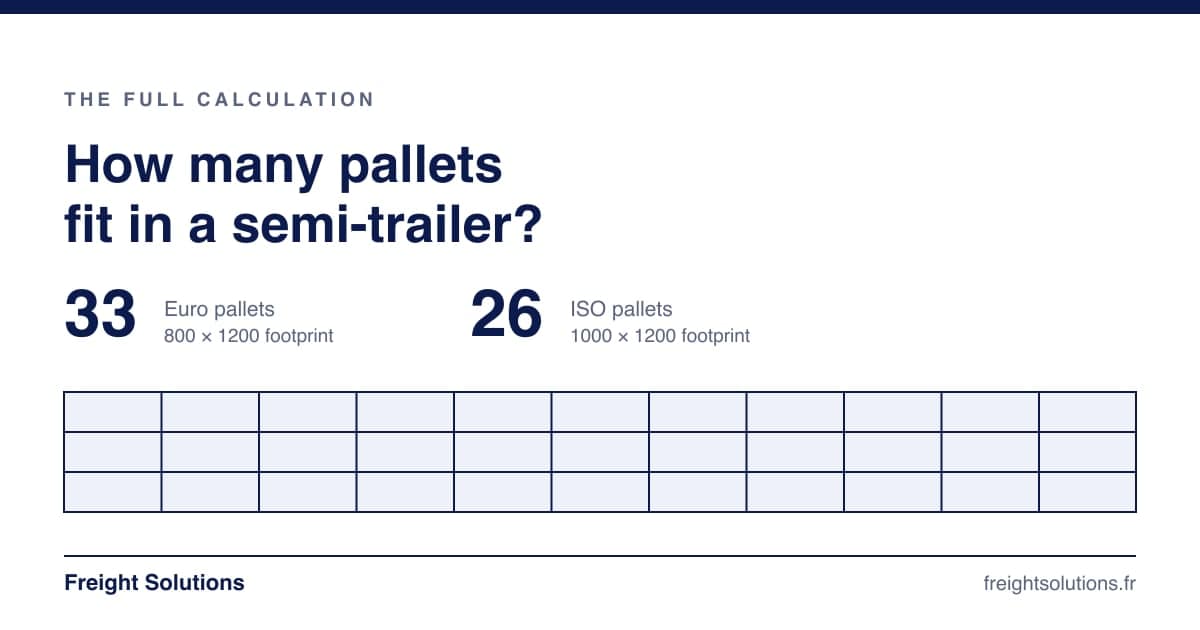
A standard 13.60 m semi-trailer takes 33 Euro pallets (800 × 1200 mm) on the floor, or 26 pallets of 1000 × 1200 mm (ISO 2 / EUR 2 format). That is the short answer, and it is the planning baseline of European road transport. Depending on the vehicle's internal dimensions and the loading plan, some configurations reach 34 Euro pallets — we come back to that below.
These figures are floor capacity, and they are not enough on their own to organise a load. Three limits apply at the same time (floor area, volume and weight), and it is always the tightest of the three that decides. Here are the full figures, based on the legislation and references cited at the end of the article.
The loading plan
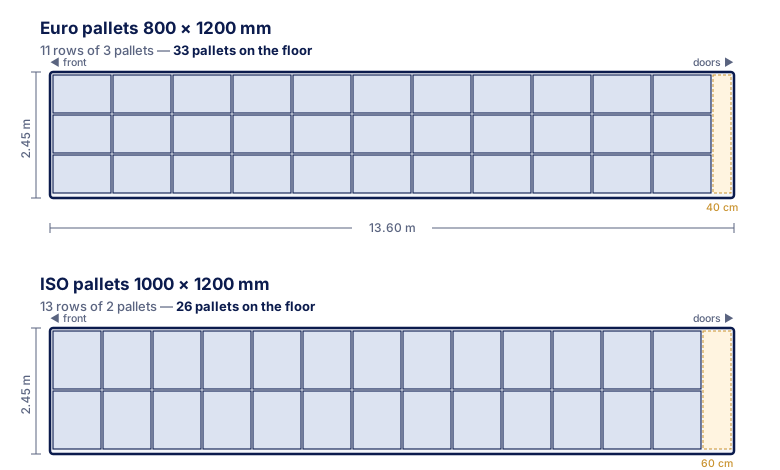
The logic is purely geometric, and it explains why the Euro pallet is sized the way it is. Three 800 mm pallets sit side by side across the width (3 × 0.80 = 2.40 m in a body of about 2.45 m), and each row takes up 1.20 m of length: 11 rows of 3, so 33 pallets, with 40 cm of floor left over.
For the 1000 × 1200 pallet — commonly called the “ISO pallet” — the reasoning turns around: two 1,200 mm pallets across the width, rows 1.00 m deep, 13 rows of 2, so 26 pallets.
Can you load 34 Euro pallets?
Yes, in certain configurations. Turning the pallets through 90°, two 1.20 m pallets cover 2.40 m of width, and 17 rows of 0.80 m take up exactly the 13.60 m of length: 2 × 17 = 34 pallets. This is not just a geometry exercise: Schmitz Cargobull, for instance, quotes 34 Euro pallets on its S.CS MEGA with 13.62 m of usable length for 2.48 m of internal width.
In practice, 33 remains the common planning baseline: the vehicle's actual internal dimensions have to allow it, no goods may overhang their pallet, and load securing must remain workable. The 34th position is therefore confirmed case by case, with the carrier.
The internal dimensions of a standard semi-trailer
The usual dimensions of a curtainsider, as documented by the industry:
| Characteristic | Usual value |
|---|---|
| Usable length | 13.60 m |
| Internal width | 2.45 to 2.48 m |
| Internal height | 2.45 to 2.80 m depending on body |
| Usable volume | ≈ 90 m³ depending on model and internal height |
| Loading metres | 13.6 ldm |
| Practical payload | ≈ 24 to 25 t |
One point to watch, straight from the field: the rear door opening can be lower than the internal height (2.50 to 2.60 m on some bodies built for dock loading). If your pallets come close to the maximum height, it is the opening you need to check, not the body.
Weight: what the regulations say
The weight limit is not a carrier's convention, it is the French Highway Code (Code de la route). Article R312-4 sets the authorised gross train weight: 40 tonnes for a combination of more than four axles in general circulation, raised to 44 tonnes for transport carried out entirely on national territory, which covers the vast majority of domestic flows, typically with a 2-axle tractor unit and a 3-axle trailer. The 44 tonnes are not automatic, though: the vehicle's technical characteristics and its registration documents must allow them.
Two further safeguards apply to combinations running above 40 tonnes: 12 tonnes maximum on the most heavily loaded axle (article R312-5) and 27 tonnes on a group of three axles (article R312-6).
Once the unladen weight of the tractor unit and trailer is deducted, 24 to 25 tonnes of goods remain in practice. Hence a calculation every shipper should do once: 33 pallets of 750 kg already come to 24.75 tonnes — and on a 34-pallet plan, the threshold drops towards 720 to 735 kg per pallet. As soon as your pallets approach 750 kg each, it is weight that limits your load, not space.
By vehicle type
| Type | Internal height | Volume | Euro pallets on the floor |
|---|---|---|---|
| Curtainsider (standard) | 2.45 to 2.80 m | ≈ 90 m³ | 33 |
| Mega | ≈ 3.00 m | ≈ 100 m³ | 33 |
| Box semi-trailer (rigid walls) | 2.45 to 2.70 m | ≈ 90 m³ | 33 |
| Refrigerated | ≈ 2.45–2.70 m | reduced by insulation | 33 |
| 19 t rigid | depending on body | depending on body | 18 to 21 |
Two practical lessons:
The mega does not take more pallets on the floor: its ~30 cm of extra height serve stacking and bulky goods. It is a volume trailer, not a floor-area one.
The refrigerated trailer carries an insulated body and a cooling unit: under identical weight regulations, its payload is mechanically lower than a curtainsider's. On dense products, that gap can force an extra vehicle — something to factor in as early as the quotation.
Stacking: up to 66 pallets
If your pallets are stackable (flat top, lower load able to carry the upper level), a semi-trailer can go from 33 to 66 Euro pallets on two levels — the maximum theoretical capacity of a 33-position plan. It is the most powerful optimisation lever in palletised transport.
Three conditions to meet:
- The combined height of the two levels stays under the internal height (around 1.20 m per pallet in a standard curtainsider, more in a mega)
- The strength of the bottom load. A useful reference: EPAL states a maximum of 5,500 kg resting on the first pallet of a stack, but your goods generally reach their own limit well before the pallet does
- The total weight and its distribution remain compatible with the vehicle: 66 pallets of 380 kg already come to ~25 tonnes
That last calculation shows the general rule: when stacking, weight becomes the dominant constraint from ~370 kg per pallet.
Loading metres and chargeable weight
In groupage, non-stackable goods are frequently priced by loading metre of floor, that is, the length of truck they occupy across the full width, because they tie up that area whatever their height. Depending on the carrier and its rate card, charging may also be based on actual weight, a chargeable weight or the number of pallets. The reference formula:
Loading metre = (length × width in metres) ÷ 2.4
| Format | Calculation | Result |
|---|---|---|
| Euro 800 × 1200 | (1.20 × 0.80) ÷ 2.4 | 0.4 ldm |
| ISO 1000 × 1200 | (1.20 × 1.00) ÷ 2.4 | 0.5 ldm |
| Half pallet 800 × 600 | (0.80 × 0.60) ÷ 2.4 | 0.2 ldm |
A quick check: on the classic plan, 33 × 0.4 = 13.2 ldm out of the 13.6 available — the 40 cm left over on the diagram are indeed there, and it is precisely that space a 34-pallet plan exploits on certain vehicles.
Then there is the notion of chargeable weight for non-stackable goods: since nothing can be placed on top of them, they are charged as if they occupied the full height. The industry then applies a conversion factor per loading metre, as a guide 1,750 kg/ldm according to market standards quoted by the major networks. The chargeable weight retained is the higher of actual weight and converted weight. Since every carrier has its own coefficient, check it as soon as you request a quotation.
The rule of three limits
To size a load, there is only one question to ask: what runs out first?
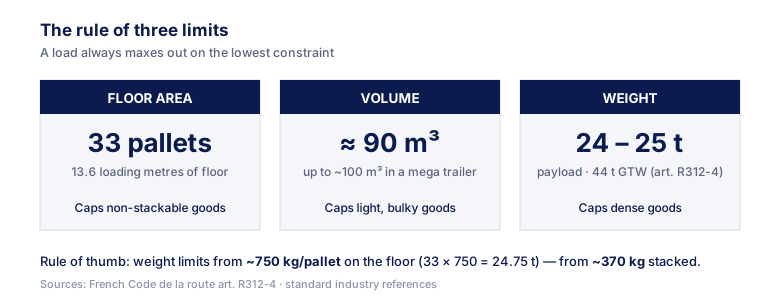
- Light, bulky goods (packaging, insulation) → volume is the limit. Think stacking and mega trailers.
- Dense goods (metals, liquids) → weight is the limit. You will hit the ~24-25 t payload well before filling the floor.
- Non-stackable goods → floor area is the limit: the 33 pallets of the classic plan, whatever their height, and a chargeable weight calculated per loading metre.
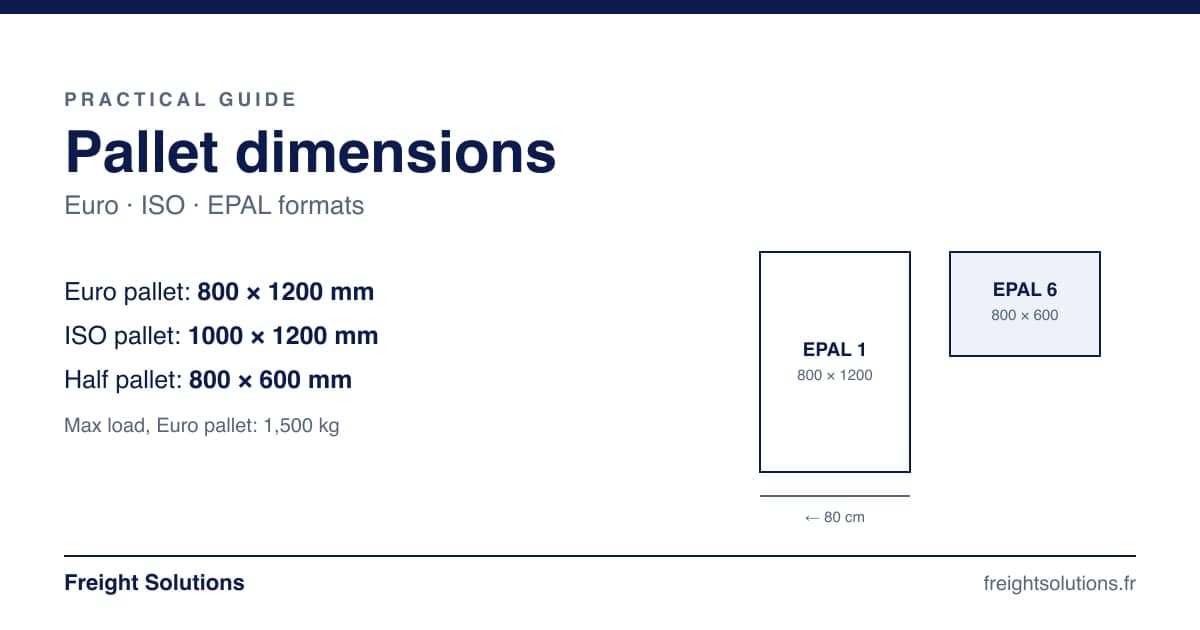
The detail of formats, permissible loads and markings is in our guide to pallet dimensions. And for a real flow, with its dock constraints, time slots and mixed formats, our teams run this calculation every day: request a quote or contact your nearest branch.
Frequently asked questions
- How many Euro pallets fit in a semi-trailer?
- 33 on the floor (11 rows of 3) in a standard 13.60 m semi-trailer — up to 34 depending on the vehicle's dimensions and the loading plan — and up to 66 when stacked on two levels, if the total weight allows it.
- Can you load 34 Euro pallets in a semi-trailer?
- Yes, in certain configurations: two pallets turned through 90° cover 2.40 m of width and 17 rows of 0.80 m fill exactly the 13.60 m, giving 34 pallets. In practice, 33 remains the planning baseline: the vehicle's actual dimensions, goods overhanging their pallet and load securing decide the 34th position.
- How many 100 × 120 pallets fit in a semi-trailer?
- 26 on the floor, in 13 rows of 2 (pallets of 1000 × 1200 mm, ISO 2 / EUR 2 format).
- What are the internal dimensions of a semi-trailer?
- About 13.60 m long, 2.45 to 2.48 m wide and 2.45 to 2.80 m high depending on the body, giving a usable volume close to 90 m³ for a standard curtainsider.
- What is the maximum weight of a semi-trailer in France?
- 40 tonnes gross train weight for a combination of more than four axles, raised to 44 tonnes for transport carried out entirely on national territory (article R312-4 of the French Code de la route), subject to the vehicle's technical characteristics. In practice, that leaves around 24 to 25 tonnes of payload.
- How many pallets fit in a 19-tonne rigid?
- 18 to 21 Euro pallets depending on the length of the body: these are the two most common configurations on the market.
- How do you calculate the loading metre of a pallet?
- Length × width in metres, divided by 2.4. A Euro pallet represents 0.4 ldm, an ISO pallet 0.5 ldm.
Sources
- Légifrance: Code de la route, article R312-4 · gross train weight limits (40/44 t)
- Légifrance: Code de la route, article R312-5 · 12 t maximum on the most heavily loaded axle above 40 t
- Légifrance: Code de la route, article R312-6 · 27 t maximum on a group of three axles above 40 t
- French Ministry for the Ecological Transition: 44-tonne FAQ · conditions for running at 44 t, axle loads
- Schmitz Cargobull: S.CS MEGA curtainsided semi-trailer · 34 Euro pallets quoted, 13.62 m usable for 2.48 m of internal width
- EPAL France: the EPAL 1 pallet · permissible loads, stacking limit of 5,500 kg
- Loading metre formula (÷ 2.4), ~1,750 kg/ldm factor, internal dimensions and floor capacities · standard professional practice in road freight transport