Logistics outsourcing means handing all or part of the goods-related operations to a specialist provider: goods-in, storage, stock management, order picking, dispatch and transport. The company keeps control (decisions, catalogue, commercial policy); the provider carries out the agreed operations and reports back, backed by data.
This guide is for executives and logistics, supply chain, transport or e-commerce managers asking themselves: what can be handed to a provider, what changes day to day, how to choose a partner, how to make the transition work. No prior logistics expertise is assumed.
What is logistics outsourcing?
Outsourcing your logistics means handing a provider the execution of physical operations, along with the resources that go with them: space, teams, equipment, systems. A contract sets the scope, the service commitments and the terms of handover. The company keeps control (decisions, catalogue, commercial policy) and, in most cases, the customer relationship, even though some extended services include logistics customer service or returns handling.
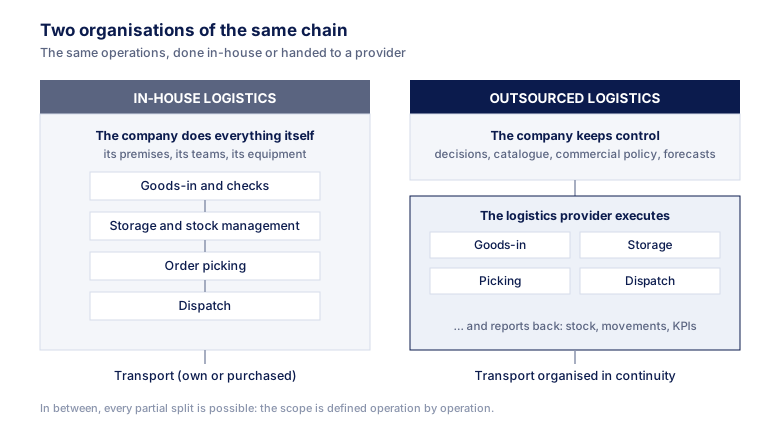
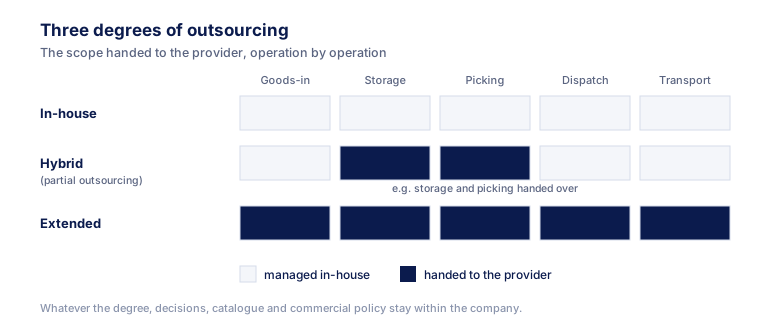
It is not all-or-nothing: between fully in-house logistics and extended outsourcing, each operation can stay with you or move to the provider. Many companies start with a narrow scope (a dormant stock, a range, a sales channel), test it, then widen it.
What can be handed to a logistics provider?
Almost all physical operations can be outsourced, together or separately:
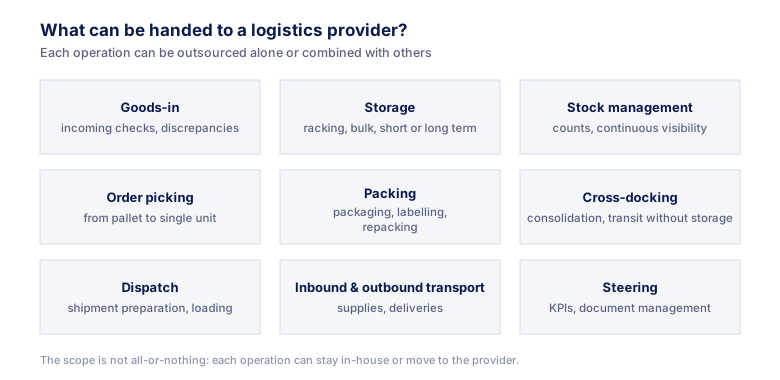
Two useful clarifications. Stock management is not storage: it is the upkeep of the data (counts, movements, levels), and it is what determines your visibility. And the scope is defined operation by operation: outsourcing "logistics" means nothing until you have said which operations, for which products, on which flows.
Why outsource? Benefits and points of vigilance
The motivations are rarely financial first: refocusing on your core business, absorbing activity swings, gaining access to expertise, better coordinating storage and transport. None of these benefits is automatic: each has its condition.
| What you gain | What it changes | The condition to obtain it |
|---|---|---|
| Expertise and processes | Proven procedures, reliable stock counts, traceability | A provider experienced with your type of products |
| Flexibility | Space and resources matched to actual activity | Shared, reliable forecasts |
| Absorbing peaks | Extra staff and priorities planned for high seasons | Terms agreed beforehand, not during |
| Refocusing teams | In-house time goes back to production and sales | A logistics contact kept in-house |
| Pooling | Shared space, equipment and skills | Accepting a multi-client site setup |
| Transport-logistics coordination | Picking and dispatch aligned with the transport plan | A single point of contact for both |
Four points remain that are not decided in day-to-day service but in the contract: reversibility (terms for returning stock and data), data exchange quality (a clean reference, an interface tested before go-live), stock visibility (available self-service, not by phone) and division of responsibilities (put in writing). None is a dealbreaker; all are settled before signing.
Finally, a point of honesty: outsourcing is not automatically cheaper than in-house logistics. The right angle is organisational, and it is measured against your actual flows, not a general principle.
Is it relevant for you? Take the test
A warehouse running out of space, lead times stretching, peaks poorly absorbed, e-commerce taking off: outsourcing projects are born from concrete situations, rarely from a theory. Nine questions to place your own situation:
How does outsourced logistics work day to day?
Once the service is in place, goods follow a marked-out path:
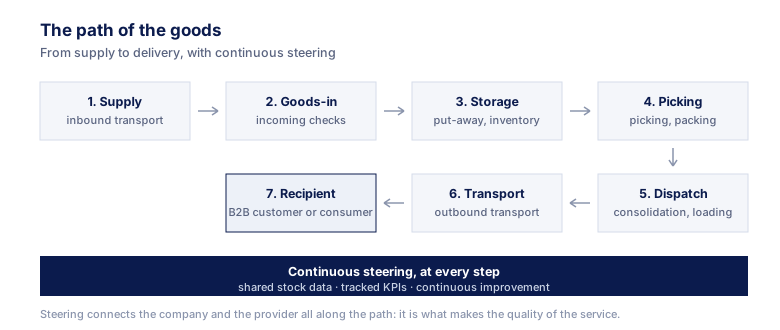
What the diagram does not show well is the layer that makes the quality of the service durable: the agreed rules (priorities, picking waves, checks before departure) and continuous steering, with shared stock data, tracked KPIs and regular check-ins. Every movement is recorded: the stock you see in the tools is the actual stock.
From project to go-live: preparing, transferring, stabilising
An outsourcing project runs in phases, and the early ones condition all the others: a difficult go-live is almost always explained by poorly prepared data or scope.
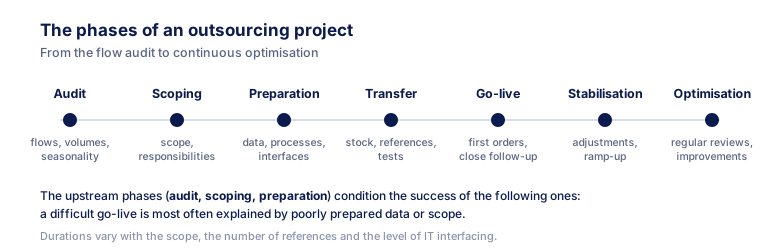
After that, three factors come up in every successful transition: clean data, tests on real flows before go-live, and close communication during the first weeks, while both sides find their routines. This work is never wasted: even if the study concludes that logistics should stay in-house, you come out of it with documented flows and KPIs.
How to choose a logistics provider?
The criteria fall into three families: understanding of your need and expertise on your products; operational solidity (processes, equipment, tracking tools, transport management); quality of the relationship (proximity, a named contact, transparency, including about what the provider cannot do). The best way to test them: visit a site in operation and ask precise questions.
And do not narrow the choice down to the price list: a service is judged on the ability to hold the level of service over time, peaks included, and on the quality of steering.
What KPIs to track with a logistics provider?
KPIs are defined in the contract, not after the first incident. Eight measures are enough, each answering a simple question:
| KPI | What it measures |
|---|---|
| Stock accuracy | The gap between the recorded stock and the physical stock found at inventory |
| Picking lead time | The time between an order being received and being made ready for dispatch |
| Picking error rate | The share of orders picked with an error (reference, quantity, recipient) |
| On-time dispatch | The share of orders dispatched within the agreed lead time |
| Goods-in quality | Put-away lead times and discrepancies found on arrival |
| Number and nature of incidents | Breakage, losses, disputes, and their resolution time |
| Transport quality | On-time deliveries, condition of goods on arrival, transport disputes |
| Stock level and turnover | The stock tied up and how fast it renews, to spot drift and dead stock |
A few well-measured KPIs are worth more than a dashboard nobody reads: what matters is measuring them the same way on both sides and reviewing them at an agreed pace.
Logistics outsourcing and e-commerce
E-commerce logistics stacks up the requirements: many single-unit orders, careful packaging, daily multi-carrier dispatch, sharp commercial peaks, returns to handle. Two points concentrate the stakes: unit picking, where an organisation built for pallets is quickly overwhelmed, and stock synchronisation with the online shop, which sells against the stock the provider sees. It is the scope most frequently outsourced by growing companies; our dedicated offer is detailed on the e-commerce logistics page.
Logistics, transport, cross-docking: a single chain
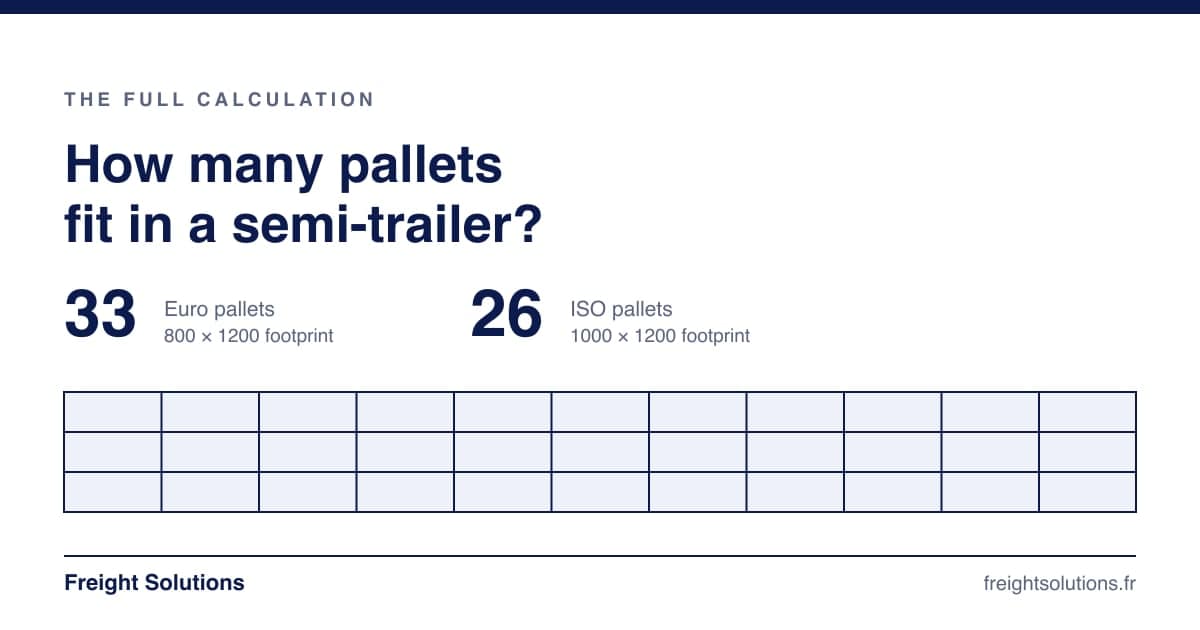
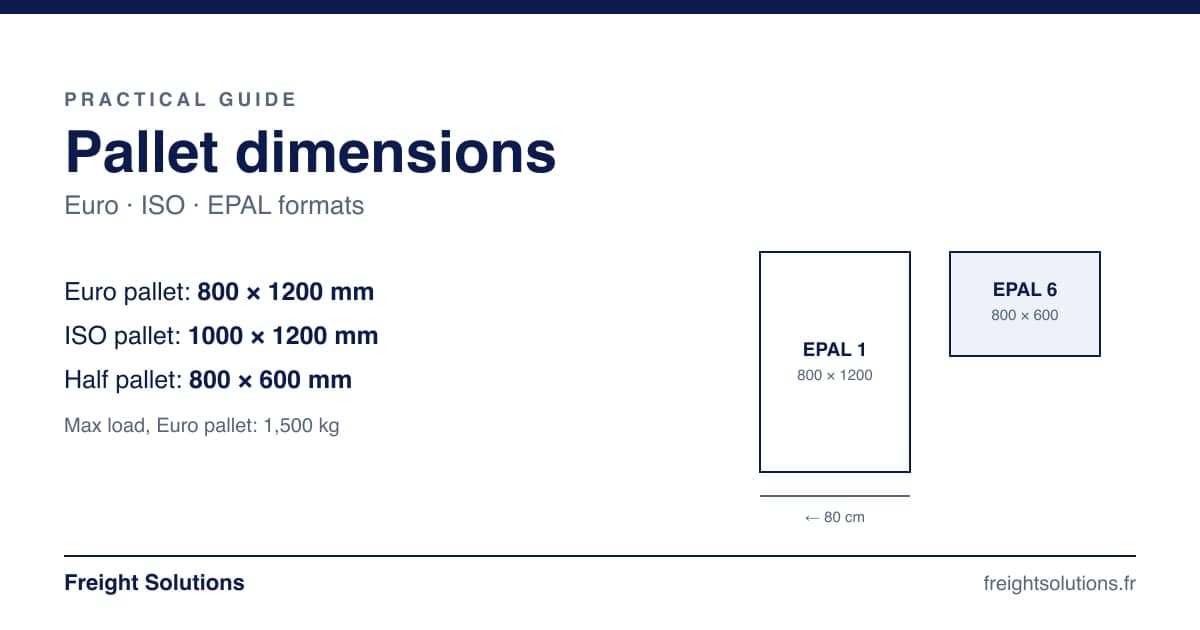
A real flow does not stop at the warehouse doors: supply → goods-in → storage → picking → dispatch → transport. Handling these links separately creates breaks: dock waiting, buffer stocks, disputes between providers passing the responsibility to each other. When picking is aligned with the transport plan, goods leave straight away, in freight forwarding for full loads or express freight for urgent shipments. For palletised flows, the loading plan is thought through as early as picking: our guide how many pallets fit in a semi-trailer covers the calculations. And internationally, the division of responsibilities is set by Incoterms.
One last call to make, flow by flow: storage or cross-docking? In the first case, goods stay in the warehouse before a later operation; in the second, they pass through with limited dwell time, sorted then re-dispatched. Many organisations combine both: stock for core references, transit for tight flows.
Outsourcing is not a goal in itself
It becomes relevant when it organises flows better, brings flexibility that is missing, or hands a specialist operations that pull the company away from its core business. The right scope (narrow, hybrid or extended) depends on your products, your volumes, your seasonality and your objectives. It is an organisational decision, to be worked out with your actual flows on the table.
This is exactly how we approach it: through a flow study, with no scope decided in advance — storage, order picking, transport, or the whole coordinated together.
Let's study the organisation of your logistics flows together
Our teams analyse your storage, order picking, transport and flow management needs, then propose an organisation suited to your business, from a narrow scope to extended coverage.
Talk about my logistics projectFrequently asked questions
- What is logistics outsourcing?
- It means handing a specialist provider all or part of the physical operations related to goods: goods-in, storage, stock management, order picking, dispatch and transport. The company keeps control and the decisions; the provider carries out the operations and reports back.
- Which logistics activities can be outsourced?
- Practically all physical operations: receiving and checking goods-in, storage, stock management, order picking, packing and repacking, consolidation and cross-docking, dispatch, inbound and outbound transport, document management. The scope is defined operation by operation.
- What is the difference between a carrier and a logistics provider?
- The carrier moves the goods; the logistics provider takes charge of them when they are not moving: goods-in, storage, picking, dispatch. Some players do both jobs and coordinate the whole, which removes the break in responsibility between warehouse and transport.
- Can you outsource only storage?
- Yes. Handing over a stock (dormant, seasonal or overflow) without outsourcing picking is a common scope, often used as a first step to test how things work with the provider.
- Can you keep part of your logistics in-house?
- Yes, that is partial outsourcing: a range, a sales channel, a geographic area or just seasonal peaks move to the provider, the rest stays in-house. This hybrid model is one of the most common.
- Is logistics outsourcing suited to e-commerce?
- It is one of its favourite grounds: unit picking, daily dispatch, stock synchronisation with the online shop, commercial peaks and returns handling all require a specialised setup, expensive to build in-house for a growing business.
- What is the difference between outsourced logistics and cross-docking?
- Logistics outsourcing is the organisational model: handing operations to a provider. Cross-docking is one technique among these operations: passing goods through with limited dwell time, without durable storage. An outsourced service can combine storage and cross-docking depending on the flow.
- How do you choose a logistics provider?
- On their understanding of your need, their expertise on your type of products, their ability to adapt, the quality of their processes and tracking tools, their transport management, their location and their transparency. A visit to a site in operation and precise questions on the processes quickly sort providers out.