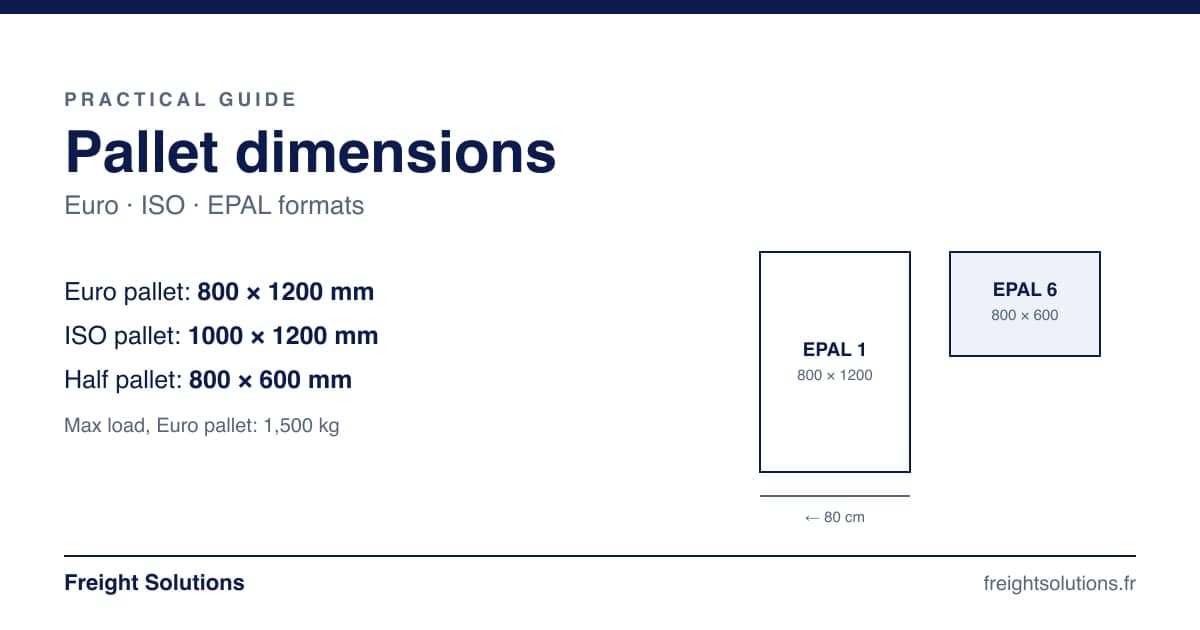
The EPAL 1 Euro pallet measures 800 × 1200 mm, and is 144 mm high. It is the reference format of European road transport. Alongside it, the 1200 × 1000 mm — often called the “ISO pallet” — is common in industry. That name is in fact a shorthand: there is no single ISO pallet, and standard ISO 6780 lists several standardised dimensions for international trade, including this format, referenced as “ISO 2” in some logistics classifications.
Floor dimensions, height, unladen weight, permissible load, stacking: the format governs handling, storage and how a truck fills up — and therefore what your transport actually costs. The characteristics of the EPAL pallets presented here are based on the specifications published by EPAL; the loading and loading-metre calculations follow standard road transport practice.
The EPAL format table
| Format | Dimensions (mm) | Area | Loading metre | Unladen weight | Permissible load | Common use |
|---|---|---|---|---|---|---|
| EPAL 1 (Euro pallet) | 800 × 1200 × 144 | 0.96 m² | 0.4 ldm | ≈ 25 kg | 1,500 kg | The European standard |
| EPAL 2 | 1200 × 1000 × 162 | 1.20 m² | 0.5 ldm | ≈ 35 kg | 1,250 kg | Industry, wide loads |
| EPAL 3 | 1000 × 1200 × 144 | 1.20 m² | 0.5 ldm | ≈ 30 kg | 1,500 kg | Industry, food sector |
| EPAL 6 (half pallet) | 800 × 600 × 144 | 0.48 m² | 0.2 ldm | ≈ 9.5 kg | 750 kg | Retail, promotions |
| Quarter pallet (display) | 600 × 400 | 0.24 m² | 0.1 ldm | n/a | n/a | In-store display |
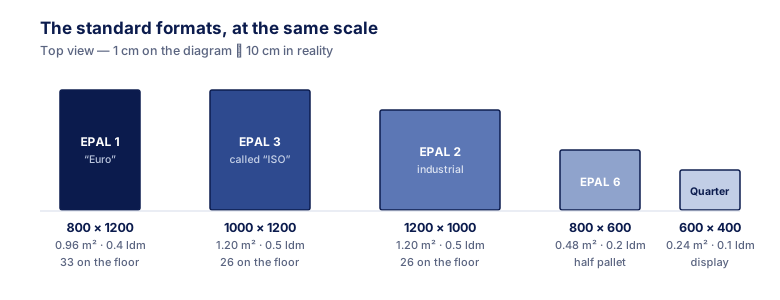
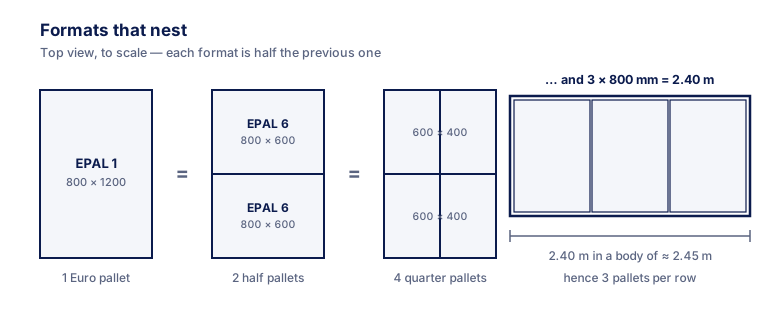
Three of these formats nest together: two 800 × 600 half pallets cover one Euro pallet, and two 600 × 400 quarters cover one half pallet. This modularity means formats can be mixed within a single load without wasting space. EPAL 2 and EPAL 3 stay outside that family: both have the same 1.20 m² area, but they are two distinct builds — 162 mm high and 1,250 kg of load for the EPAL 2, 144 mm and 1,500 kg for the EPAL 3.
One caveat, though: permissible load cannot be inferred from area. According to EPAL specifications, the EPAL 3 carries 1,500 kg just like the EPAL 1 (with a stacking limit reduced to 4,500 kg on the bottom pallet), while the EPAL 6 half pallet is capped at 750 kg of load and 1,500 kg in a stack. Every model has its own load and stacking specifications: it is the EPAL data sheet for the format that governs, not its size.
The Euro pallet (EPAL 1) in detail
This is the reference of European road transport. Its characteristics are set by the technical regulations of EPAL (European Pallet Association):
| Characteristic | Official EPAL value |
|---|---|
| Dimensions | 800 × 1200 mm |
| Height | 144 mm |
| Unladen weight | ≈ 25 kg |
| Permissible load (uniformly distributed) | 1,500 kg |
| Max load on the bottom pallet of a stack | 5,500 kg |
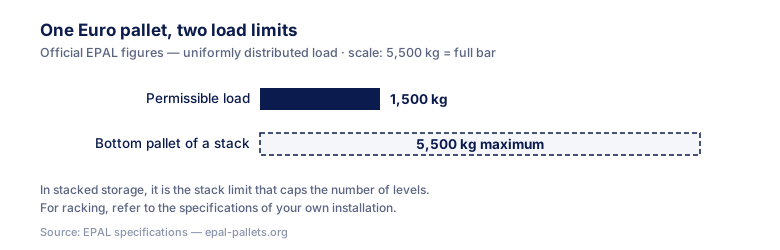
That last line is the least known and one of the most useful: when loaded pallets are stacked on a solid, level surface, the total weight resting on the first pallet in the stack must not exceed 5,500 kg. It is that value, defined by EPAL, that really bounds what you can stack in storage. Other figures circulate (static load, racking load), but they do not appear in the characteristics published by EPAL: in racking, it is the specifications of your own storage installation that apply.
Why 800 × 1200? Because the format is built around the truck: two pallets side by side make 1,600 mm, three make 2,400 mm, to fit an internal width of 2.45 to 2.48 m depending on the semi-trailer. Three pallets per row, and the floor is taken up across almost the full width.
EUR, EPAL: what is the difference?
On dimensions, none: both markings refer to the same 800 × 1200 mm format. On the system, there is a difference. “EUR” is the historic marking inherited from European railways, attached to the pool managed by the UIC (Union Internationale des Chemins de fer, the International Union of Railways). “EPAL” designates the pool of the European Pallet Association, which manages its own manufacturing and repair licences and its own quality control. A compliant EPAL pallet carries the “EPAL in the oval” marking on the left and right blocks (systematically since August 2013), and the phytosanitary treatment details on the centre block.
The two systems are no longer equivalent: the exchangeability agreement between EPAL and the UIC ended on 1 May 2017, so a EUR/UIC pallet is not automatically accepted in exchange for an EPAL pallet. More broadly, compliant dimensions are not enough to make a pallet exchangeable: the marking, the condition of the pallet and the terms agreed between shipper, carrier and consignee determine whether it is accepted into an exchange scheme.
Beware of counterfeits too, which are increasingly in circulation: only EPAL-licensed companies are authorised to produce or repair these pallets.
ISPM 15 marking for export
For a shipment outside the European Union, check the phytosanitary requirements of the destination country: many of them require solid wood packaging, pallets included, to be treated in accordance with the international standard ISPM 15 (NIMP 15). The most common treatment is heat treatment — the core of the wood is held at 56 °C for at least 30 minutes — and it is attested by the regulatory IPPC marking applied to the pallet. A non-compliant load can be held, treated or turned back at customs on arrival.
The good news: new EPAL pallets have been treated and marked in accordance with ISPM 15 since 1 January 2010, so they are compliant from the outset. The point to watch concerns reused pallets from outside the EPAL system, whose treatment is not guaranteed.
What each format gives you in a semi-trailer
The pallet format directly determines how a truck fills up. In a standard 13.60 m semi-trailer:
| Format | Pallets on the floor | Arrangement |
|---|---|---|
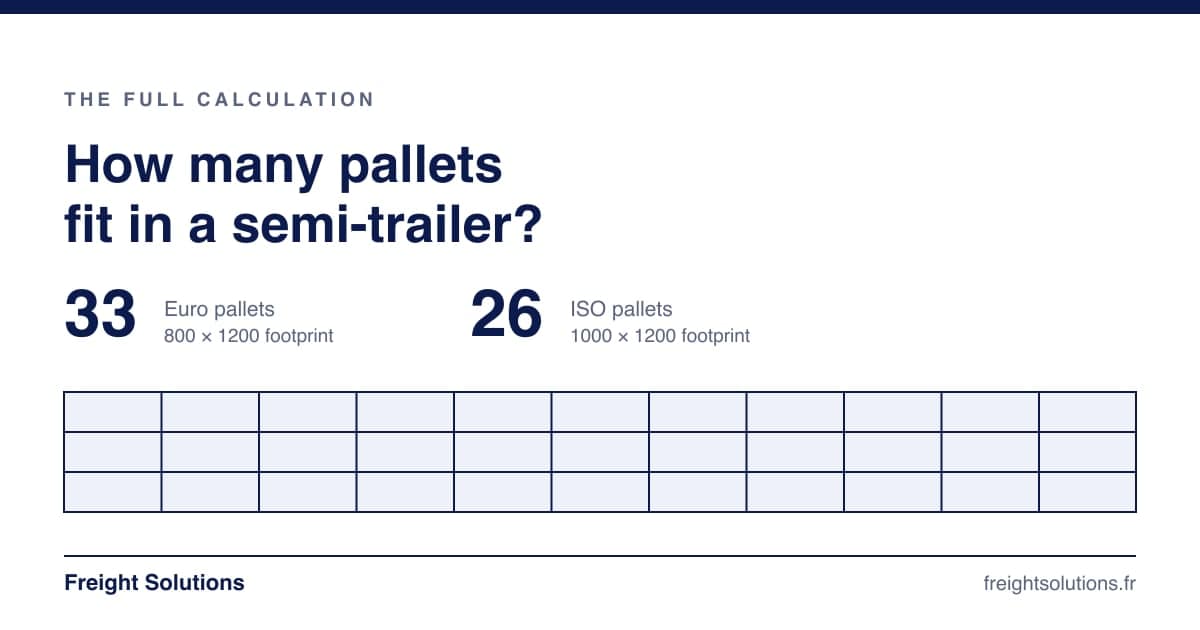
| Euro 800 × 1200 | 33, up to 34 depending on configuration | 3 per row × 11 rows |
| 1200 × 1000 (so-called “ISO”) | 26 | 2 per row × 13 rows |
That simple gap weighs on the invoice. In groupage, consignments are often priced by loading metre of floor, that is, the length of truck occupied across its full width — even though every carrier applies its own rate card: actual weight, chargeable weight, number of pallets or loading metres. The industry reference formula:
Loading metre = (length × width of the pallet in metres) ÷ 2.4
That is 0.4 ldm for a Euro pallet and 0.5 ldm for a 1200 × 1000 pallet, 25 % more linear occupancy. When the carrier's rate card charges by loading metre, that gap feeds straight into the cost of groupage. On a regular flow, the choice of format is not a packaging detail: it is a line in your transport budget.
The detail of loading calculations (stacking, chargeable weight, trailer types) is in our dedicated article: how many pallets fit in a semi-trailer?
Which format to choose
The 800 × 1200 (Euro) is the most widespread format in European road flows: excellent floor efficiency in a standard semi-trailer, well-established exchange schemes, docks and equipment sized for it. You still need to check that it suits your products, your equipment, your consignee's constraints and the pallet exchange scheme envisaged.
The 1200 × 1000 makes sense when your products are more than 80 cm wide; it is found in particular in certain industrial, chemical and food flows.
The 800 × 600 half pallet is a retail tool more than a transport one: it goes straight onto the shop shelf without repacking, which makes it the preferred medium for promotional operations.
And if you are hesitating over a specific flow, that is literally our trade: ask us for a quote, our teams will work out the loading plan with you.
Frequently asked questions
- What are the dimensions of a Euro pallet?
- 800 × 1200 mm on the floor, for a height of 144 mm. That is the EPAL 1 format, the standard of European road transport.
- What weight can a Euro pallet carry?
- According to EPAL specifications, up to 1,500 kg as a uniformly distributed load. In a stack, the bottom pallet must never carry more than 5,500 kg. For racking storage, refer to the capacities of your own installation.
- How much does an empty Euro pallet weigh?
- Around 25 kg. That weight is added to your goods in the chargeable weight of the consignment.
- What is the difference between a EUR pallet and an EPAL pallet?
- The format is the same: 800 × 1200 mm. But the markings refer to two distinct systems — the EPAL pool on one side, the EUR/UIC pool on the other — whose exchangeability agreement ended in 2017. A EUR/UIC pallet is therefore not automatically exchangeable for an EPAL pallet: the marking, the condition of the pallet and the terms agreed between the parties decide whether it is accepted.
- Does a 100 × 120 pallet fit in a standard semi-trailer?
- Yes: 26 pallets of 1200 × 1000 on the floor of a 13.60 m semi-trailer, against 33 Euro pallets. The difference is a matter of footprint, not incompatibility.
- What is ISPM 15 marking?
- The international phytosanitary marking for wood packaging (standard ISPM 15 / NIMP 15), required by many countries outside the European Union. The most common treatment heats the core of the wood to 56 °C for 30 minutes. All new EPAL pallets have carried it since 2010.
Sources
- EPAL International: the EPAL 1 Euro pallet (EPAL Euro pallet) · 800 × 1200 × 144 mm, ≈ 25 kg, load 1,500 kg, stack 5,500 kg
- EPAL International: the EPAL 2 pallet · 1200 × 1000 × 162 mm, ≈ 35 kg, load 1,250 kg, stack 4,250 kg
- EPAL International: the EPAL 3 pallet · 1000 × 1200 × 144 mm, ≈ 30 kg, load 1,500 kg, stack 4,500 kg
- EPAL International: the EPAL 6 half pallet · 800 × 600 × 144 mm, ≈ 9.5 kg, load 750 kg, stack 1,500 kg
- EPAL: end of the exchangeability agreement with the UIC on 1 May 2017 · EUR/UIC pallets are no longer officially exchanged within the EPAL pool
- ISO 6780:2003: flat pallets for intercontinental materials handling · principal standardised dimensions, including 1200 × 800 and 1200 × 1000
- IPPC: standard ISPM 15 (NIMP 15), wood packaging in international trade · approved treatments and regulatory marking of wood packaging
- Loading metre formula (÷ 2.4) and capacities of 33/26 · standard professional practice in road freight transport